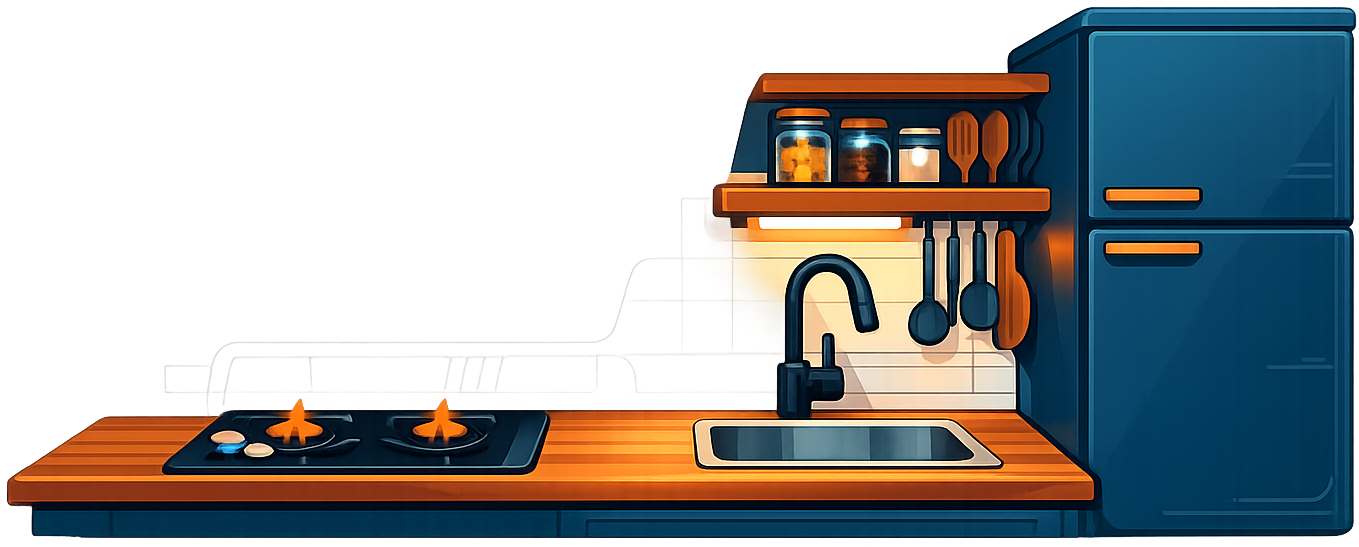
How much kitchen do you need?
Kitchens range from a single burner and a jug to a full galley with a big fridge and counters. Match it to how you actually eat: a weekender who mostly grills outside needs far less than a full-timer who cooks every meal aboard. More kitchen means more space, weight, power, and water, so start from your habits.
How you cook is the pivot. Induction is clean and dry but a big electrical load; gas is power-light but adds moisture and needs ventilation and alarms. Choose the one whose trade-offs fit your build.
Cooking: induction vs gas
- Induction (electric). Fast, precise, and adds no flame or combustion moisture indoors. The catch is power: a burst of induction cooking pulls a lot of watts, so it needs a capable inverter and a healthy battery and solar system.
- Propane / gas. Power-light and works anywhere, which is why it is still common. But an open flame releases water vapor and combustion products into the cabin, so it needs good ventilation and a carbon-monoxide (and ideally propane) alarm, plus safe gas storage and plumbing.
- Butane / alcohol single burners. Cheap and simple for minimalist builds, with the same ventilation caveats as any open flame.
The fridge
A 12V compressor fridge is the norm, far more efficient than an absorption cooler. It is usually the single biggest daily electrical load, so it drives your battery sizing:
- Size it to your food habits; bigger boxes cost more energy every day.
- Chest-style fridges hold cold better when opened; upright drawers are easier to reach.
- Account for its daily watt-hours in your power budget, and remember it runs harder in hot weather.
Sink & water
Even a small sink transforms daily life. Tie it into your water system: a 12V pump, a faucet, and a drain to the gray tank. A deeper single basin is more useful than a wide shallow one, and a tall or pull-out faucet makes filling pots and washing up far easier in a tight space.
Counter & storage
- Counter space is always scarce; a fold-out or over-sink cover extends it when you need it.
- Deep drawers beat cabinets in a moving vehicle: they hold contents in place and are easier to access.
- Secure latches on everything, so nothing flies open on a rough road.
- A pantry nook keeps dry food organized and off the counter.
Ventilation
Cooking is a major source of heat and moisture. Run the roof fan while you cook to pull it straight out, especially with a gas flame. This is the cheapest way to keep windows clear and the van comfortable.
If you cook with gas, mount a carbon-monoxide alarm (and a propane alarm, since propane pools low) and always crack a vent. If you cook with induction, make sure the inverter and battery can handle the burst load before you rely on it.
Common mistakes
- Induction without the power to back it, then tripping the inverter.
- Gas without ventilation or the right alarms.
- An oversized fridge quietly draining the battery daily.
- Too little counter space and no fold-out extension.
- Cabinets instead of drawers, spilling their contents on rough roads.
Quick checklist
- Right-size the kitchen to how you actually eat
- Pick cooking: induction (power) or gas (ventilation + alarms)
- Size the 12V fridge and budget its daily power
- Plumb a sink into the water and gray systems
- Plan counter space, deep latched drawers, and a pantry
- Vent while cooking; add CO/propane alarms for gas