
How a van electrical system works
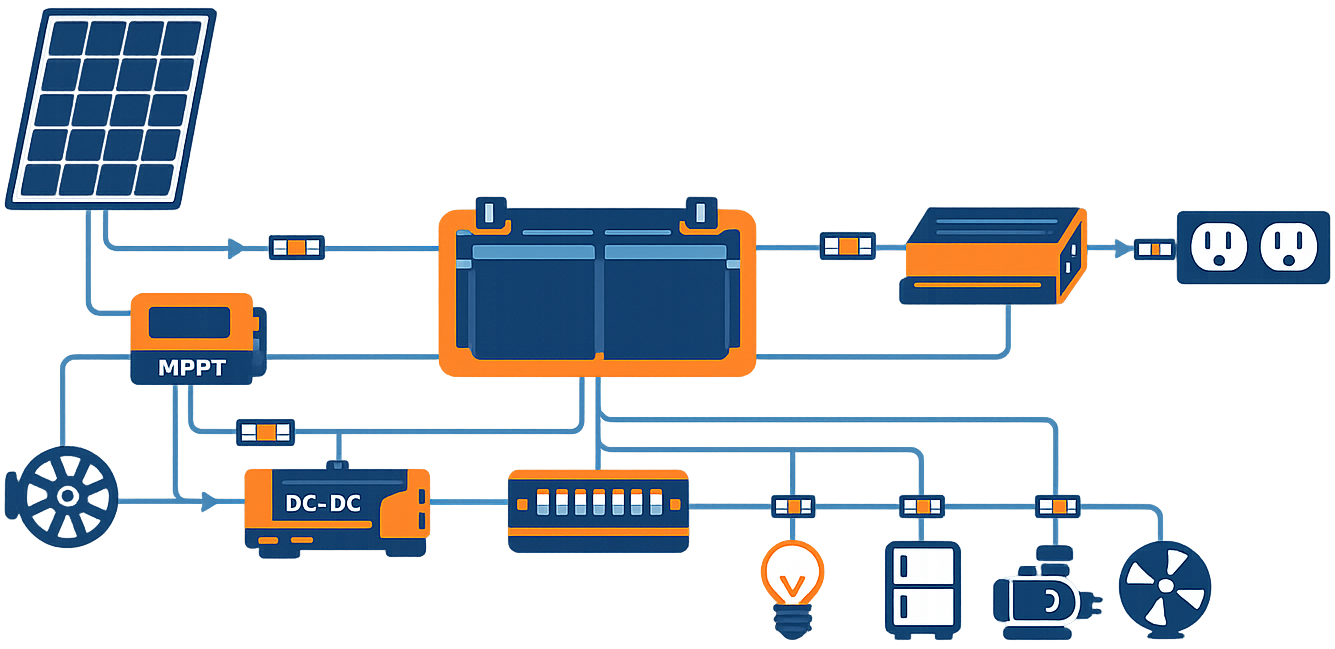
Almost every van build is a small off-grid power plant with four parts:
- A battery bank stores energy, almost always 12V lithium (LiFePO4) today.
- Charging sources refill it: solar panels, the vehicle alternator, and shore power when you plug in.
- A DC distribution side runs your 12V loads directly: lights, fridge, water pump, roof fan, USB.
- An inverter converts 12V DC to 120V AC for household plugs, only when you need them.
Everything downstream follows from one number: how much energy you use in a day, measured in watt-hours (Wh). Get that right and the rest is arithmetic.
Design from your loads, not from a battery size you saw online. Two people with a laptop and a fridge need a very different system than a weekender with lights and a fan.
Start from your loads
List every electrical thing you will run, and estimate its daily energy: watts × hours per day = watt-hours per day. Some rough per-day figures for a typical build:
- 12V compressor fridge: 500–700 Wh
- LED lights: 40–80 Wh
- Water pump: 20–40 Wh
- Roof fan: 100–200 Wh
- Laptop + phones: 150–300 Wh
- Starlink: 500–1,000 Wh
- Induction cooktop: 300–900 Wh (short, high-power bursts)
Add them up to get your daily load. A common two-person build lands around 1,000–1,800 Wh per day. Our battery & solar calculator does this addition and the sizing below for you; this guide explains what it is doing.
Sizing the battery
Your battery has to carry you through the hours (and cloudy days) when the sun is not charging. Two factors set the size:
- Usable capacity. LiFePO4 batteries can safely use about 85–90% of their rated capacity. A 100Ah battery gives roughly 85Ah usable, or about 1,090 Wh at 12.8V.
- Days of autonomy. How long you want to last with poor charging. Most builders design for 1 to 2 days.
The rough formula:
Battery (Ah) = daily Wh × days of autonomy ÷ (12.8 × 0.85)
So a 1,400 Wh/day build wanting 1.5 days of reserve needs about 1,400 × 1.5 ÷ 10.9 ≈ 193Ah, which you would round up to 200Ah. Most two-person off-grid builds land somewhere between 200 and 400Ah.
Lithium hates charging below freezing. In cold climates, choose batteries with a built-in heater or a BMS that blocks cold charging, and keep the bank inside the insulated space.
Sizing solar
Solar has to replace what you used, during the limited hours the sun is usable. Two factors here:
- Peak sun hours. Not daylight hours, but the equivalent hours of full-strength sun. Figure 3–4 in winter or the north, 5–6 in summer or the southwest.
- Real-world derate. Panels rarely hit their rating. Plan on about 75% after heat, angle, wiring, and controller losses.
The rough formula:
Solar (W) = daily Wh ÷ (peak sun hours × 0.75)
That same 1,400 Wh/day build, at 4 sun hours, needs 1,400 ÷ 3 ≈ 470W, so around 500W of panels. If you rely on solar as your main charger, round up generously; roof space, not panels, is usually the limit.
Other charging sources
Solar is rarely the whole story. Two other sources matter:
- Alternator (DC-DC charger). A DC-DC charger pulls power from the engine while you drive, safely and at a controlled rate. If you move every few days, this can do more charging than solar, and it works at night and in rain. Highly recommended for full-timers.
- Shore power. A charger/inverter that tops the bank up from a campground pedestal or a garage outlet. Great insurance for long stationary stretches or a stretch of bad weather.
Think of the three as a team: solar for daily trickle, alternator for driving days, shore power as backup.
Inverter & AC loads
An inverter makes 120V AC for anything with a household plug. Size it to your largest simultaneous AC load, not your battery:
- Laptops, TV, small chargers: a 600–1,000W pure sine inverter is plenty.
- Induction cooktop, microwave, hair dryer: you need 2,000W or more.
- Air conditioning changes everything: it is a large, sustained load that usually forces a bigger battery and solar array.
Always choose a pure sine wave inverter; modified sine can damage sensitive electronics. Remember every AC watt is pulled from your 12V battery plus inverter losses, so AC cooking is expensive in battery terms.
Wiring, fuses & safety
This is the part that starts fires if done wrong, so treat it seriously or hire it out.
- Fuse every positive wire near its source. A fuse protects the wire, so it goes at the battery/bus-bar end, sized to the wire, not the device.
- Size wire to current and length. Undersized wire overheats. Use an ampacity chart and account for voltage drop on long runs.
- Use bus bars for clean, common positive and negative connections instead of stacking rings on the battery.
- Add a main battery disconnect so you can kill the whole system.
- Follow a standard. ABYC marine wiring practice is the common reference for 12V van systems.
High currents, lithium batteries, and 120V AC can cause fires, shocks, and injury. If you are not fully confident, have the electrical designed or inspected by a qualified professional, and always test before buttoning up walls.
Common mistakes
- Buying the battery first. Size from loads, or you will over- or under-build.
- Forgetting charging. A huge battery with tiny solar and no DC-DC charger stays empty.
- Undersized or unfused wire. The number one fire risk.
- Cooking on the inverter without the battery and solar to back it, then wondering why the bank dies by evening.
- Charging lithium below freezing and damaging the cells.
Quick checklist
- Add up daily watt-hours from every load
- Battery Ah = daily Wh × autonomy ÷ 10.9
- Solar W = daily Wh ÷ (sun hours × 0.75)
- Add a DC-DC charger if you drive regularly
- Pure sine inverter sized to your biggest AC load
- Fuse every positive at the source; size wire to an ampacity chart
- Main disconnect, bus bars, and a test before you close the walls