
Ventilation first: the roof fan
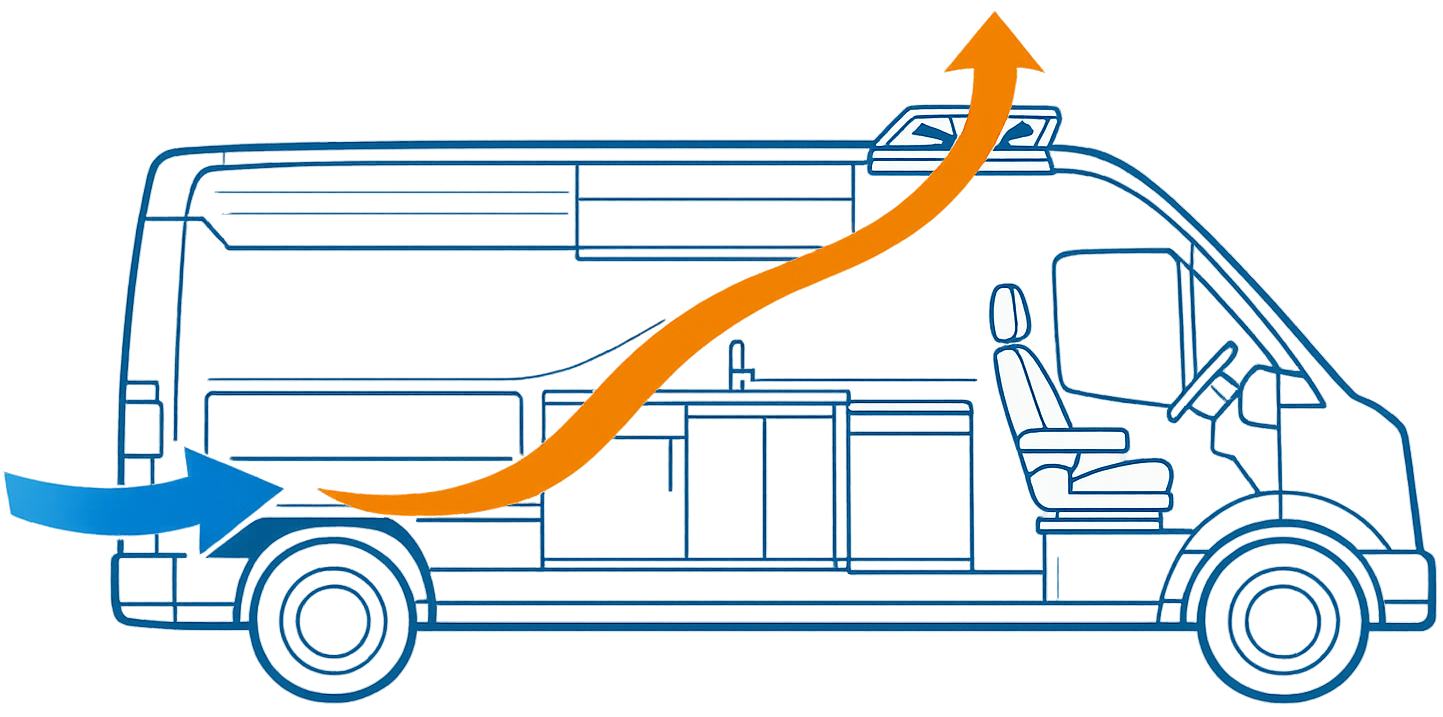
The single most valuable cooling tool in a van is a roof fan. Pulling hot air out (or drawing cool air in) keeps the interior near outside temperature instead of baking well above it, and it clears the moisture and cooking heat that build up inside. If you do one thing for summer comfort, install a good variable-speed roof fan.
For most climates, ventilation and shade, not air conditioning, are what keep a van livable. AC solves a narrower problem: humid heat you cannot escape by moving.
Passive cooling
Free and battery-free, these do most of the work:
- Park in shade and point the smallest, most-insulated side (often the back) at the sun.
- Cover the windows. Insulated reflective covers on the glass block a surprising amount of solar heat; the windshield is the biggest offender.
- Chase the weather. The freedom of a van is that you can drive to cooler elevation or the coast.
- Awnings and reflective roofs cut the heat load before it gets inside.
Airflow strategy
Moving air feels cooler and flushes heat. Aim for cross-ventilation: an inlet low and on the shaded side, an outlet high (the roof fan on exhaust), so hot air leaves and cooler air is drawn in. A cracked window opposite the fan, or a second small fan, sets up a through-breeze. Small 12V fans aimed at people add comfort for almost no power.
Insulation cuts heat gain
Insulation is not just for winter. The same wall that holds heat in during the cold slows heat coming in during summer, and keeps the interior from swinging with every cloud. See insulation & condensation; a well-insulated, well-shaded van stays cool far longer and lets a fan keep up.
When you actually need AC
Ventilation has limits. When the air itself is hot and humid, and you cannot drive somewhere cooler, moving that air around does not help much. That is the case for air conditioning: humid southern summers, sleeping in hot cities, or traveling with pets who cannot be left in the heat. Be honest about whether that is your reality or an edge case.
12V air conditioning
Modern 12V DC air conditioners (mini-splits and rooftop units) can run off the battery, but they are a large, sustained load. Running one overnight can demand a serious battery bank and a lot of solar or alternator charging, so AC is a whole-system decision, not a bolt-on.
- Plan the electrical system around the AC from the start; it usually drives up battery and solar size.
- Rooftop units are simpler to install; split units are quieter and more efficient but more work.
- Shore power makes AC easy when available, since you are not draining the bank.
Air conditioning is the heaviest electrical load in most builds. Do not add it as an afterthought: size the battery and charging for it first, or plan to run it mainly on shore power.
Before committing to AC, maximize the cheap wins: a strong roof fan, reflective window covers, good insulation, and parking smart. Many full-timers cross hot country comfortably with no AC at all.
Common mistakes
- Skipping the roof fan and relying on cracked windows alone.
- Leaving windows uncovered in direct sun.
- Bolting on AC without sizing the battery and solar for it.
- No cross-ventilation, so hot air just sits inside.
- Forgetting insulation helps in summer too.
Quick checklist
- Install a good variable-speed roof fan
- Make insulated reflective covers for the windows
- Set up cross-ventilation: low inlet, high outlet
- Insulate to slow summer heat gain
- Decide honestly whether you need AC for your climate
- If AC, size the battery and charging around it first