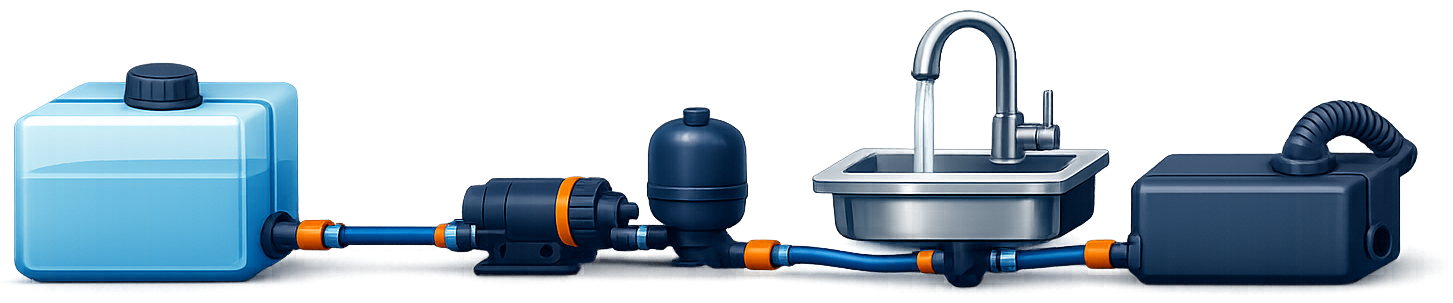
The parts of a water system
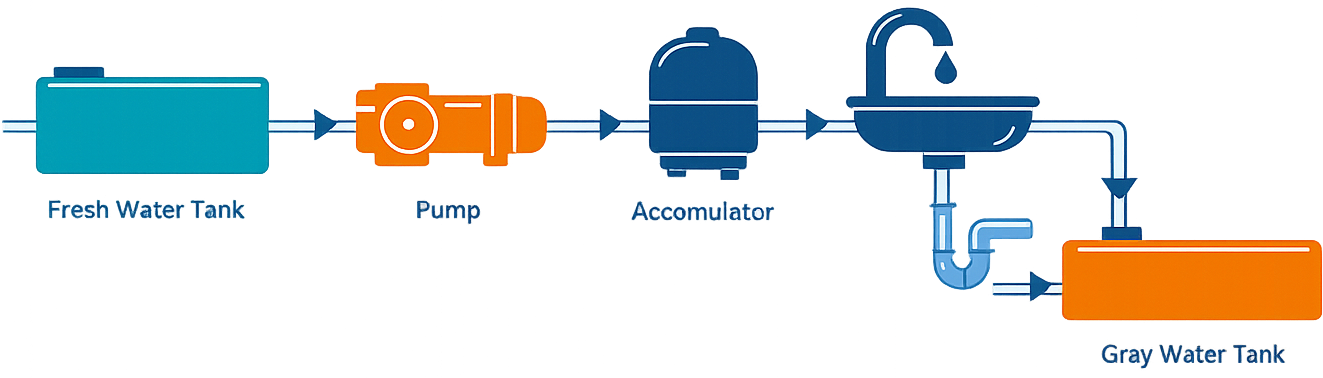
Most builds share the same chain:
- Fresh tank holds your clean water.
- A 12V pump pressurizes the lines when you open a tap.
- Plumbing (usually flexible PEX) carries water to a sink, and maybe a shower.
- A gray tank catches the used water so you are not dumping it on the ground.
- Optional hot water from a heater, ranging from a simple kettle to an on-demand unit.
Water weighs 8.34 lb per gallon. A 40-gallon tank is over 330 lb, a big chunk of your payload. Size for how you really travel, not the biggest tank that fits.
How much water do you need?
Estimate it directly: people × gallons per day × days between fills. Usage varies enormously with your habits:
- Minimalist (drinking, cooking, dishes, no indoor shower): 1–2 gallons per person per day.
- Comfortable with an indoor shower: 4–6 gallons per person per day.
Two people who refill every 5 days at 4 gal/day want roughly 40 gallons fresh. Many van builds settle between 20 and 40 gallons as a balance of range and weight. Our water calculator works this out and sizes the gray tank too.
Fresh water
- Tank type: a fixed under-mount or interior tank for capacity, or portable jugs for simplicity and easy filling. Jugs are underrated for weekend builds.
- Filling: campgrounds, spigots, potable water stations, and many gas stations. A good inlet and a short hose make this painless.
- Filtration: a sediment/carbon filter improves taste and protects the pump; a finer filter or UV is worth it if you fill from uncertain sources.
- Sanitizing: flush the system with a mild bleach solution periodically to keep it fresh.
Pumps & plumbing
- Diaphragm pump: the standard 12V pump. Choose one with adequate flow (around 3+ GPM) for a comfortable tap.
- Accumulator tank: a small add-on that smooths pressure so the pump cycles less and the flow is steady rather than pulsing.
- PEX tubing: flexible, freeze-tolerant, and easy to join with push-fit fittings, ideal for the tight, curved runs in a van.
- Foot or hand pump: a simple, power-free alternative for minimalist builds.
Mount the pump on a soft pad and add an accumulator; it turns a loud, pulsing pump into a quiet, steady one, a small change that makes daily life much nicer.
Gray water
Gray water is the used water from your sink and shower. Collect it in a gray tank rather than draining onto the ground.
- Size the gray tank to at least match, ideally slightly under, your fresh capacity so it does not overflow before you refill.
- Dump only at approved dump stations, campgrounds, or facilities, never on the ground or down a storm drain.
- Keep it as clean as you can: strain food scraps at the sink and use biodegradable soap so the tank does not turn into a smell problem.
Dumping gray water on the ground is illegal in many places and bad practice everywhere. Carry it to a proper dump station. It is part of being welcome as a van traveler.
Hot water & showers
Options range from trivial to full plumbing:
- Kettle or pot: the simplest hot water, fine for dishes and a rinse.
- On-demand (tankless) heater: propane or diesel units that heat water as it flows, for a real shower without a big tank.
- Heat-exchange and hydronic setups: advanced systems that use engine or heater warmth, worth it mainly for four-season, full-time builds.
An indoor shower adds a wet bath, more water use, more gray water, and moisture to manage (see insulation & condensation). Many travelers happily skip it in favor of an outdoor shower and gym or campground facilities.
Freeze protection
Water expands when it freezes and can split tanks, pumps, and fittings. If you travel in the cold:
- Keep tanks and plumbing inside the insulated, heated space, not in an exposed underbelly.
- Be able to drain the system quickly for hard freezes or storage.
- Run your heater (see the climate guides) to keep the living space, and the plumbing in it, above freezing.
Common mistakes
- Oversizing the fresh tank and carrying hundreds of pounds you rarely use.
- No gray tank, leaving you with nowhere legal to put used water.
- Exposed plumbing that freezes and cracks the first cold night.
- A loud, pulsing pump with no accumulator or soft mount.
- Adding a wet bath without planning for the extra water, gray, and moisture.
Quick checklist
- Size fresh water from people × gallons/day × days between fills
- Gray tank roughly matched to fresh capacity
- 12V pump with adequate flow, soft mount, and an accumulator
- PEX plumbing kept inside the insulated space
- A filter on the fill, and a plan to sanitize periodically
- A way to drain the system for freezes and storage
- Only ever dump gray at approved stations