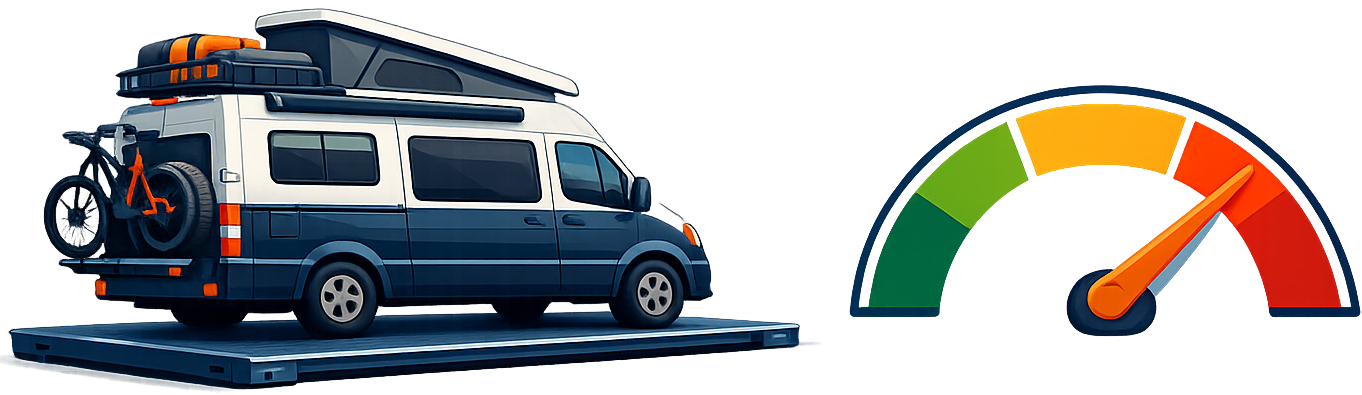
Why weight matters
Every van has a manufacturer weight limit. Go over it and you are not just risking a ticket:
- Safety. Overloading lengthens braking distance, strains tires and suspension, and hurts handling in a crosswind or an emergency swerve.
- Legality. Exceeding the rating is illegal in many places and can be checked at weigh stations.
- Insurance. An overloaded vehicle can complicate or void a claim after an incident.
- Wear. Tires, brakes, and bearings all age faster when you run heavy.
Payload = GVWR - curb weight. It is everything you add: the build, water, fuel, people, and gear. Know this number before you design, not after.
GVWR, curb weight & payload
- GVWR (Gross Vehicle Weight Rating). The maximum the loaded van may weigh, set by the manufacturer. Found on the door-jamb sticker.
- Curb weight. What the empty van weighs from the factory, with fluids.
- Payload. The difference, and your real budget for the whole build plus everything in it.
- Axle ratings (GAWR). Each axle also has its own limit, so where weight sits matters, not just the total.
Payload varies a lot by platform and trim, from roughly 3,000 to 4,000+ lb on common vans. Our vehicle comparison lists payload for each, and the weight calculator checks a build against it.

Where the weight goes
A loaded build adds up faster than people expect. Rough figures for a typical two-person van:
- The build itself (walls, furniture, electrical, plumbing, appliances): 800–2,000+ lb.
- Fresh water: 8.34 lb per gallon, so 40 gallons is over 330 lb.
- People: figure about 160 lb each.
- Gear, food, tools, and personal items: 200–500 lb, and always creeping upward.
Add those to the curb weight and it is easy to see how a build with a big water tank and a heavy interior eats an entire payload.
Estimating your build weight
You do not need perfect numbers, just a realistic tally. Weigh or look up major items as you go: batteries, water full, appliances, plywood and framing, and the vehicle’s starting curb weight. Keep a running spreadsheet. The weight & payload calculator turns your estimate of build weight, water, and people into a remaining-payload figure and flags when you go over.
Add a 10–15% buffer to your estimate. Builds gain weight from glue, fasteners, wiring, and the hundred small things that never make the list.
Staying under payload
If the math is tight, the biggest levers are:
- Right-size the water. Water is heavy and easy to overspec; carry what you actually use (see water systems).
- Choose lighter materials. Thinner plywood, aluminum framing, and lightweight furniture add up.
- Go lithium. LiFePO4 is far lighter than lead-acid for the same usable energy.
- Start with more payload. If you have not bought yet, pick a higher-payload platform or an uprated/dual-rear-wheel option.
- Suspension helps ride, not rating. Airbags and upgraded springs improve how a heavy van drives, but they do not raise the legal GVWR.
Suspension upgrades can make an overloaded van feel fine, which is exactly the trap. The GVWR is a legal and engineering limit; feeling stable does not make it legal or safe.
Weighing the finished van
When the build is done, drive it fully loaded (full water and fuel, people and gear aboard) onto a public scale, such as a CAT scale at a truck stop. Ask for per-axle weights so you can confirm both the total against GVWR and each axle against its GAWR. It is cheap, quick, and the only way to know for sure.
Common mistakes
- Never checking payload until the build is finished and already over.
- Oversizing the water tank and carrying hundreds of unused pounds.
- Ignoring axle limits by loading heavy items all at one end.
- Assuming airbags raise the rating. They do not.
- Forgetting people and gear in the tally.
Quick checklist
- Find your GVWR (door jamb) and curb weight; payload is the difference
- Tally build, full water, people, and gear against payload
- Add a 10–15% buffer for the small stuff
- Right-size water and choose lighter materials and lithium
- Mind each axle’s rating, not just the total
- Weigh the finished van, fully loaded, per axle at a public scale