Why lithium won
For years vans ran on lead-acid or AGM batteries. Lithium iron phosphate (LiFePO4) has almost entirely replaced them for good reasons:
- More usable energy. You can safely use 85–90% of a lithium battery, versus about 50% for lead-acid, so a 100Ah lithium does the work of nearly two 100Ah lead batteries.
- Far longer life. Several thousand cycles instead of a few hundred, often outlasting the rest of the build.
- Lighter and smaller for the same usable capacity, which matters for payload.
- Fast, flat charging. It accepts a high charge current and holds voltage steady until nearly empty.
The trade-offs are a higher up-front price and a sensitivity to cold, both manageable.
Compare batteries on usable watt-hours and cycle life, not sticker price. A cheaper battery you can only half-drain, that dies in two years, is not cheaper.
Reading a spec sheet
A few numbers tell you almost everything:
- Capacity (Ah). Amp-hours at the rated voltage. Multiply by voltage for energy: 100Ah × 12.8V ≈ 1,280 Wh.
- Nominal voltage. A 12V LiFePO4 pack actually sits around 12.8–13.2V for most of its charge.
- Continuous & peak current. How many amps it can deliver steadily and in bursts. Your inverter’s draw must stay within this.
- Cycle life. Cycles to a stated remaining capacity (e.g. 3,000 cycles to 80%).
- Operating & charging temperature. Note that the safe charging range is narrower than the discharge range.
Usable capacity, not rated capacity
Design your system around what you can actually use. With LiFePO4 at roughly 85% usable depth of discharge, a 200Ah bank gives about 170Ah, or around 2,180 Wh, of real, day-to-day energy. That usable figure is what you plug into the battery sizing in the electrical guide and into our calculator.
The BMS: the brain inside
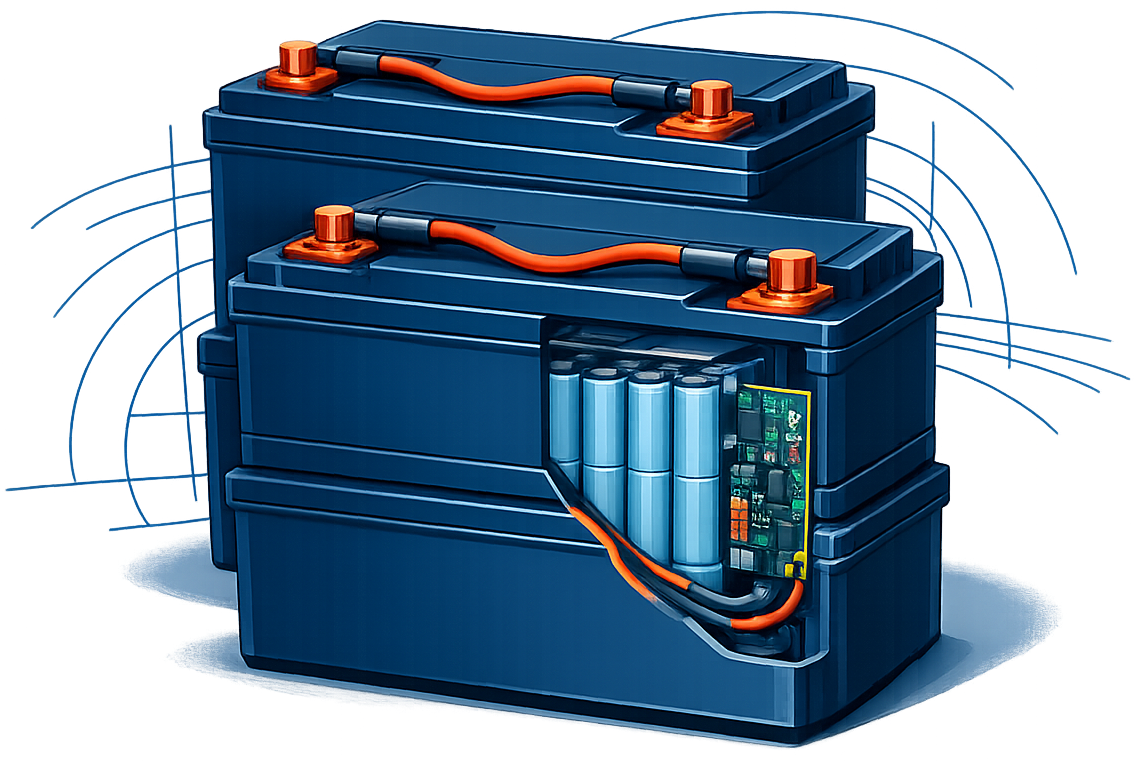
Every quality lithium battery has a built-in Battery Management System. It quietly protects the cells by disconnecting on over-discharge, over-charge, over-current, and out-of-range temperature, and by keeping the internal cells balanced.
The BMS is a safety backstop, not a charging strategy: you still want a charger with a correct LiFePO4 profile. And because the BMS can cut off suddenly at its limits (for example, in the cold), you should design so it rarely has to.
Cold-weather charging: the big gotcha
This is the rule that catches people out: you must not charge LiFePO4 below freezing (0°C / 32°F). Charging cold permanently damages the cells. Discharging in the cold is fine; charging is not.
Three common solutions:
- Buy batteries with a built-in self-heating element that warms the cells before accepting charge.
- Keep the bank inside the insulated, heated living space so it stays above freezing.
- Use a charger or BMS that blocks charging when the battery is too cold.
Never charge a lithium battery that is below freezing without a heating provision. It is the single most common way people quietly ruin an expensive bank.
Wiring the bank
To grow capacity, wire identical batteries in parallel (same voltage, more Ah). Wiring in series raises voltage (for example, two 12V to make 24V), which some larger systems use to cut current and wire size. Keep a few habits:
- Use identical batteries (same brand, capacity, and age) in a bank.
- Make cable runs to each battery equal length so they share load evenly.
- Fuse the bank and follow the same wiring and fusing practice as the rest of the system.
A battery monitor (a shunt-based gauge) is worth every penny. It shows true state of charge in amp-hours, turning guesswork into a number you can trust.
Common mistakes
- Buying on price instead of usable Wh and cycle life.
- Charging below freezing and killing the cells.
- Mixing old and new or mismatched batteries in one bank.
- Relying on the BMS as the charger instead of a proper LiFePO4 charge profile.
- No monitor, so you never really know your state of charge.
Quick checklist
- Size on usable watt-hours (about 85% of rated) and cycle life
- Match batteries in a bank; parallel for more Ah
- Chargers set to a correct LiFePO4 profile
- A cold-charging plan: heated cells, warm location, or cutoff
- Fuse the bank; equal-length cables
- Fit a shunt-based battery monitor