Why wiring is the safety-critical part
A well-sized battery and solar array mean nothing if the wire between them overheats. The whole job of wiring and fusing is to make sure that when something goes wrong, a fuse blows instead of a wire melting inside your wall. Once you internalize a few rules, it becomes routine, but the rules are not optional.
A fuse protects the wire, not the device. So the fuse is sized to the wire and placed at the source (the battery or bus-bar end), where a short would otherwise dump the full battery current into the cable.
Wire gauge & ampacity
Every wire can only carry so much current before it heats up. That limit is its ampacity, and it depends on the wire’s cross-section (gauge) and how it is bundled and cooled. Two things drive your choice:
- Current. Add up the amps the circuit will carry and pick a gauge rated comfortably above it.
- Length and voltage drop. At 12V, long runs lose meaningful voltage. A wire that is fine for ampacity may still need to be thicker to keep voltage drop under about 3% on a long run.
Use a wire-gauge/ampacity chart and a voltage-drop calculator (both are in the electrical references), and when in doubt, go one size thicker. Thicker wire runs cooler and drops less voltage; the only downsides are cost and stiffness.
Fuses & breakers
A fuse or breaker is the sacrificial link that opens the circuit before the wire is damaged. The rules:
- Fuse every positive conductor leaving a power source, close to that source.
- Size the fuse to the wire’s ampacity, not to the appliance. The device’s own needs are usually smaller; the fuse exists to protect the cable.
- Big cables need big protection at the battery: a main fuse (such as an ANL or Class-T) sized to the bank and inverter.
- Breakers can double as switches for larger circuits (like solar or the inverter), which is convenient for service.
An unfused or oversized-fuse positive cable is the classic van fire. A dead short across a lithium bank can deliver hundreds of amps in an instant. Protect every positive run at its source, no exceptions.

Bus bars & distribution
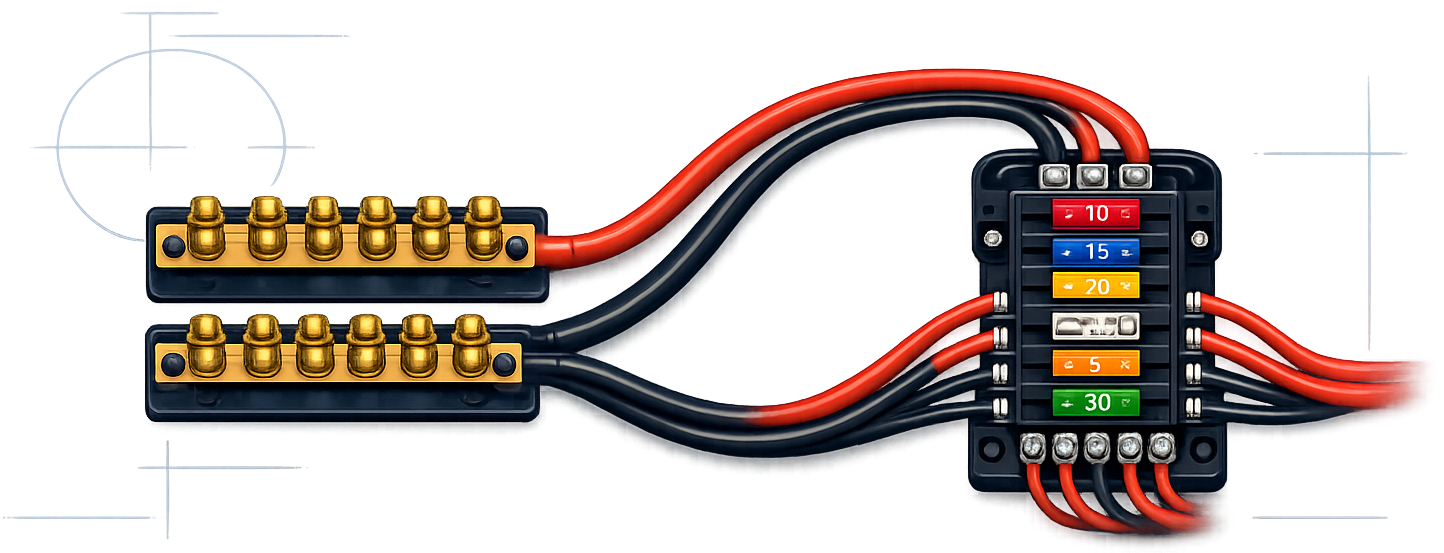
Rather than stacking a dozen ring terminals on the battery posts, run one heavy positive and negative cable to a pair of bus bars, then branch your circuits from there through a fused distribution block. This keeps connections tidy, makes the battery post clean and safe, and gives you a single, logical place to add or service circuits later.
The main disconnect
Fit a battery disconnect switch on the main positive so you can isolate the whole system for service, storage, or an emergency. It is a small part that turns a scary job (working on a live 12V system) into a safe one, and it protects the bank from slow drains during long storage.
DC vs AC wiring
Most of the van is low-voltage 12V DC. If you add an inverter or shore power, you also have 120V AC, which is household-lethal and follows its own rules:
- Keep AC and DC wiring separate and clearly identified.
- Use proper AC practice: correct cable, GFCI protection on outlets, and a considered connection between shore power, inverter, and any transfer switch.
- If you are not confident with AC and shore power, this is the part to have done or inspected by a qualified electrician.
Grounding
In a 12V system the negative side is the return path, and the vehicle chassis is commonly used as a ground reference. Make solid, clean ground connections to bare metal, keep the battery negative, chassis, and system grounds properly bonded per your components’ instructions, and do not rely on a rusty or painted contact point for a high-current return.
Label both ends of every wire, leave a little service loop, and keep a simple wiring diagram. Future-you, chasing a fault at a campsite, will be grateful.
Common mistakes
- Unfused or under-fused positive cables at the source.
- Undersized wire that overheats or drops too much voltage on long runs.
- Fusing to the device instead of to the wire.
- Mixing AC and DC or treating 120V casually.
- No main disconnect, so every repair is a live one.
- Poor grounds to painted or rusty metal.
Quick checklist
- Size wire to current and to voltage drop over its length
- Fuse every positive at its source, sized to the wire
- Main battery fuse and a main disconnect switch
- Bus bars and a fused distribution block for clean branching
- AC kept separate, GFCI-protected, and done to code
- Solid grounds to clean bare metal
- Label wires, keep a diagram, and test before closing walls